


Nobody Owes You Their Attention: 3 Screenwriting Techniques That Make Fundraising Content Stand Out
At NIO Summit 2026, copywriter and screenwriter Amy Harrison explained why polished fundraising content is so easy to ignore, and shared three techniques from film and TV that help nonprofits tell succinct stories people will remember.
For about 20 years, Harrison has helped organizations use content to reach the right people and move them to buy, sign up or donate. She uses her work with medical equipment as an example – an area where people are spending six figures on complex equipment, but sales reps often only have five minutes with customers to tell a compelling story.
At NIO Summit, Harrison argued that it all comes down to the same problem. Whether you’re pitching a screenplay, selling medical equipment, or asking for a donation, she said, “nobody owes you their attention. You have to earn it.”
The AI Trap: Respectable doesn’t mean memorable
“Now, if nobody owes you their attention, it makes sense to notice what they pay attention to,” Harrison said.
People ignore thousands of ad messages a day, she said, but then crash a website the same day to buy tickets to a film they’re excited about. People will pay attention. They’re just selective about what they pay attention to. This is where screenwriting techniques come in, because they’re designed to engage and pull people in.
That gap matters more than ever now that AI can turn out perfectly respectable content and design in minutes or seconds.
“But respectable doesn’t mean memorable,” Harrison said.
Because every organization has access to the same tools, polish alone won’t set anyone apart.
Harrison notes that she uses AI every day and isn’t arguing against it. Her concern is where it sits in the process. AI is good at creating, and at laying out conventions: copywriting formulas, persuasion techniques and what’s working for others in your sector
However, AI has questionable judgment, and shouldn’t decide direction, or what is worth making. She described a CEO who began sending his marketing team daily memos built on what ChatGPT “thought” they should be doing.
The team deflated, she said, because he wasn’t trusting their skills. He was “outsourcing judgment.”
“AI is great for conventions. It can lay out copywriting techniques, storytelling techniques, storytelling persuasion, and it can share what’s worked, what’s working now, what other people are doing in your industry. These are all great things to pay attention to,” she said. “But just because something has worked in the past doesn’t necessarily mean it’s what we should be doing next.”
Every best practice, every convention was once a new idea, Harrison added. So in addition to following convention, she encouraged marketers to go out and find that new idea that could become best practice.
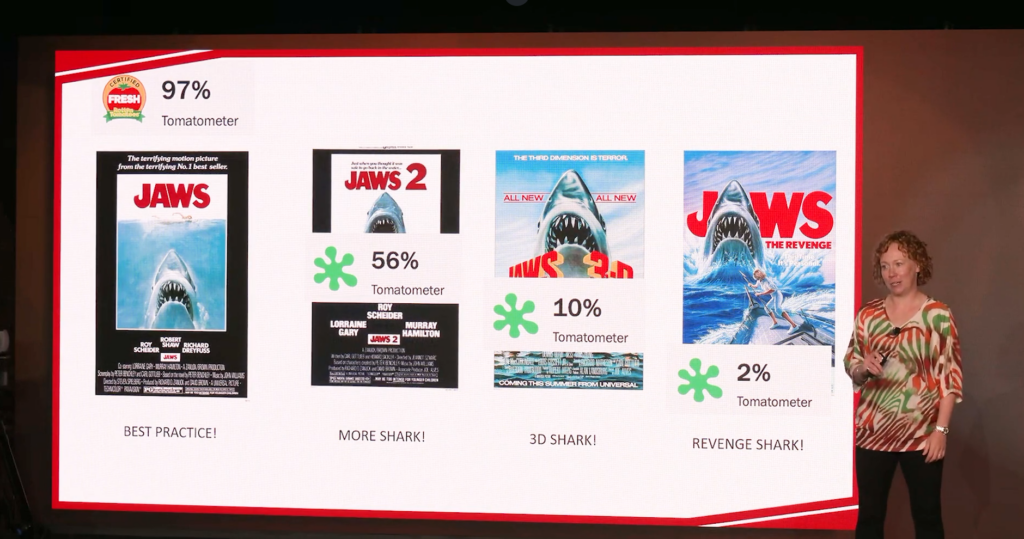
Her example was Jaws, the film classic and filmmaking gold standard.
“That’s a best practice,” she said. “And you can just imagine afterwards, producers going, ‘How do we do that again?’”
Their answer being a little too simple: more shark.
You start out with a best practice gold standard, but the more you try to repeat that same formula with “sequels” the less successful you are at it.
“So we want to be asking ourselves,” she said, “is this worth making? Will this genuinely delight, inspire, or surprise our audience?”
Get Proven Digital Fundraising Strategies in Your Inbox Each Week
3 Techniques to Help Your Content Stand Out
Technique 1: Change the angle by looking somewhere unexpected
“You can absolutely talk about the same subject, as long as you’re treating it in a new way,” said Harrison.
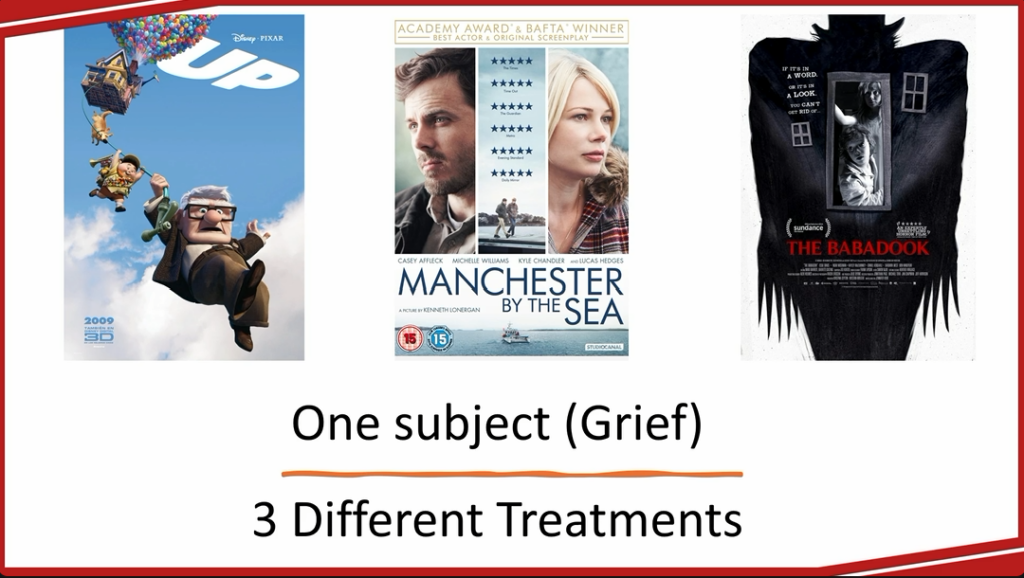
Screenwriters don’t abandon a subject because someone else has covered it. Harrison showed three films about grief: an animated comedy, an intimate drama and a psychological horror. They share a subject and take three very different approaches to it. Fundraisers can do the same with causes donors think they already understand.
Harrison goes through an exercise she calls the unseen scene. She gets teams to answer three questions:
- What do you want someone to care about?
- What do people expect to see?
- What’s an Unseen Scene?
The UK homeless charity Shelter did this with stories of people who were experiencing hidden homelessness, who weren’t sleeping outside, but had no home of their own. One featured Diana, a young woman sleeping on her uncle’s sofa after her mother died.
Find the unseen scene. Harrison uses a “day in the life” exercise, where the team would pick someone they served and walk through their day as they experience it.
For Diana, that surfaced moments most donors wouldn’t picture, like packing her things up every morning, having nowhere permanent to keep her clothes, and when she did look for more permanent accommodations, she experienced housing rejection from landlords because she was so young.
Combine familiar themes. A new angle doesn’t always require a brand-new idea, Harrison said. You can pair two familiar ones, such as when the UK domestic abuse charity Refuge staged a video as a glossy property tour.
The presenter praises each feature of a house the way an estate agent would, while revealing the more sinister element of how each one could be used to control someone inside it. Such as perfect lockable storage space in the kitchen, where your partner could lock up your phone or medication. A gorgeous stove that is “perfect for gaslighting.”
To find pairings like that, Harrison does simple word association with pen and paper. Write your central theme – in this case, domestic violence – and list everything it brings to mind, highlight the words that jump out, then look for two that create a contrast. In this case, “fear” and “looks respectable” were combined to create an unexpected angle on a familiar story.
The result doesn’t have to be shocking, she said. It just has to be unexpected.
Technique 2: Sharpen the focus by finding the human detail
“Detail is so important to use if you want people to care about what you do,” said Harrison.
Harrison explained why by giving the example of a familiar frustration: friends who insist you watch a new show but can only tell you it’s amazing, fantastic, so good – but they can’t really tell you why, exactly.
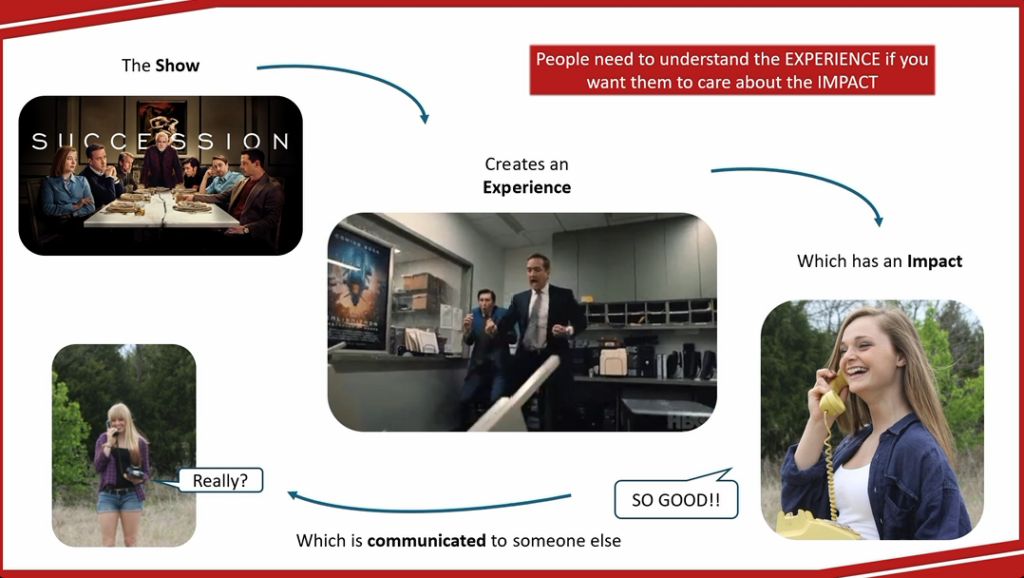
They had the experience and you didn’t. Without details of that experience, she said, their enthusiasm about its impact doesn’t land.
Nonprofit marketing often makes the same mistake. A program creates an experience, the experience creates an impact, and organizations jump straight to the impact, without bothering with the details.
“If you focus on impact alone, it’s very easy to ignore,” she said.
Harrison showed a full-page magazine ad from a UK homeless charity built on lines about empowering homeless people and creating a path forward.
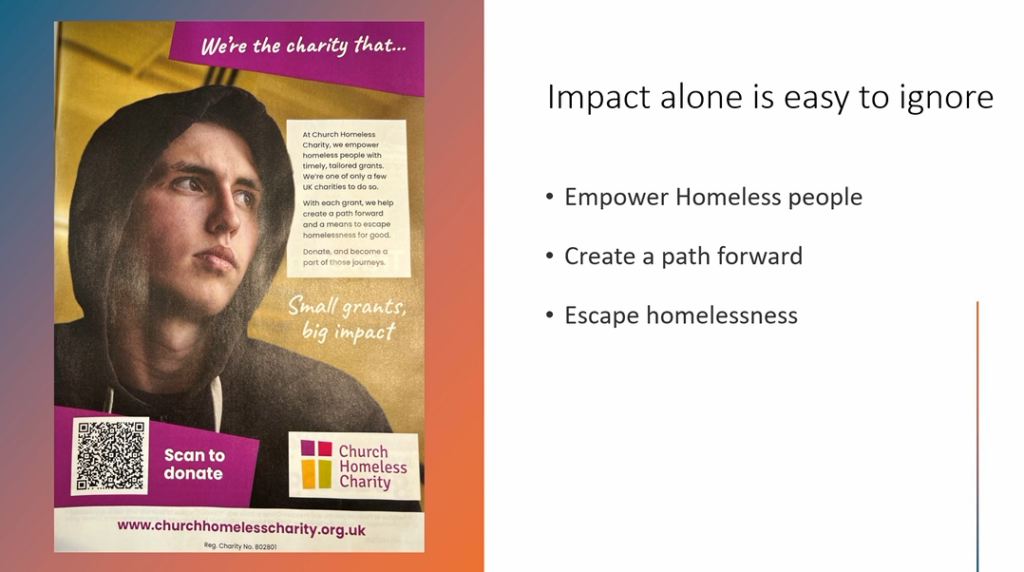
“Nothing is wrong here, it’s all correct. But that’s almost the problem. It’s so correct that my brain just skips over it,” she said.
If marketers are investing in a platform to reach people, she added, “I really do encourage you to be bold, and say something specific.”
Harrison pressed the audience to remember one of the oldest pieces of screenwriting advice: “show, don’t tell.”
The charity’s own website had these kinds of “show me” stories that the ad needed. The website described helping a young man stay in college, an Easter buffet that drew residents out of their rooms and out of isolation, and a music therapy course that built self-esteem, among others.
Harrison’s fix for the advertisement was to build the ad around one of those stories.
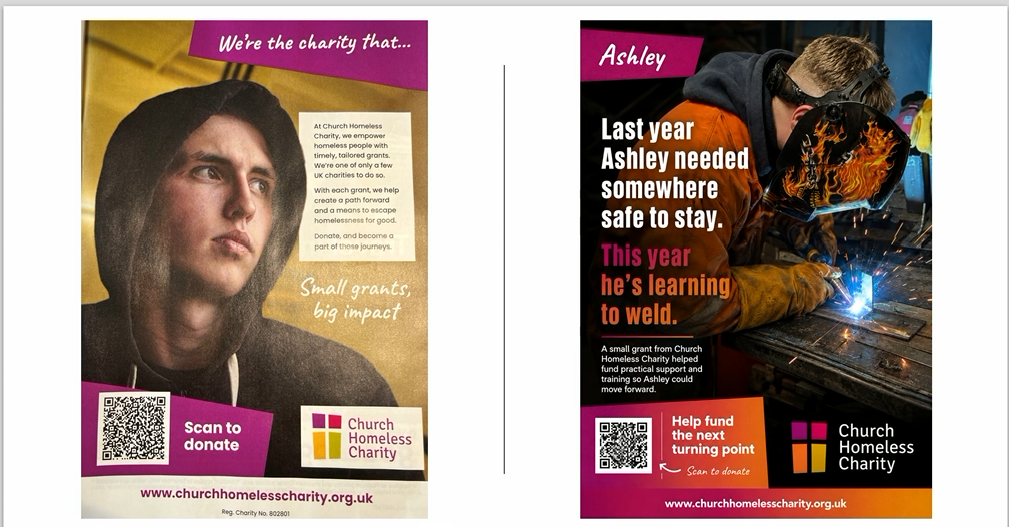
“Now I’m not saying that it should look exactly like this, but what matters is that we’re moving from a generic claim about what we do and the impact to specific details about a story that people can understand,” she said.
“Show don’t tell” doesn’t mean that you need images or video, she added. In writing, detail does this work.
She gives the example of the film Big Fish, where the main character, Edward Bloom, is a “master storyteller” who can make makes a legendary fish believable with small specifics: the hundred-dollar lures it has stolen, and theories that it’s the ghost of a drowned thief or a dinosaur left over from the Cretaceous period.
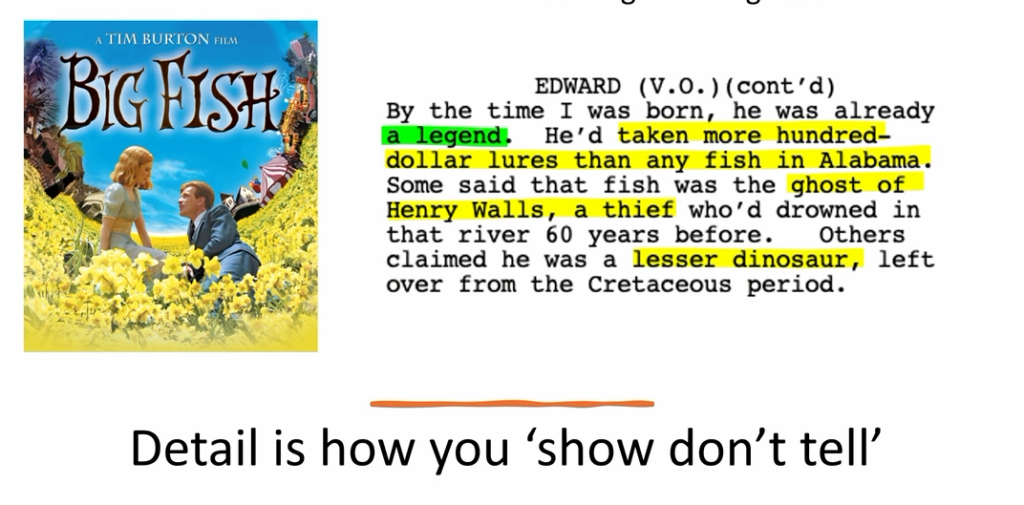
“That’s the extra detail that pulls us into the story. And it’s hard work,” Harrison said, “but it’s worth that effort if you want to stand out.”
She offered two ways to find better detail:
Activate the senses. Harrison played a video of a child opening a shoebox of gifts for the “Santa Shoebox Project.”
Instead of writing that a donation “brought this child joy,” ask what you can see, hear, touch, smell or taste. The answers might be a soft jumper against the girl’s cheek, children shouting, cardboard ripping and a squeal when she finds a toothbrush. The exercise, she said, helps you notice details you’d otherwise skim past.
A deeper way to get detail: get people talking. When Harrison is working with people, she waits for the moment when they stop telling her what they think is relevant, and transition into what makes them “really fired up.”
“When you’re looking for stories, you don’t want to dismiss ideas too soon,” she said. “It’s a bit like looking at a river and saying, ‘well, that’s just water and rocks, there’s no gold in there.’”
One way to find gold, she continued, is to set up relaxed conversations with staff, colleagues, donors, and volunteers, and even start with yourself. Ask what makes you emotional, what frightens you, what makes you laugh or get angry.
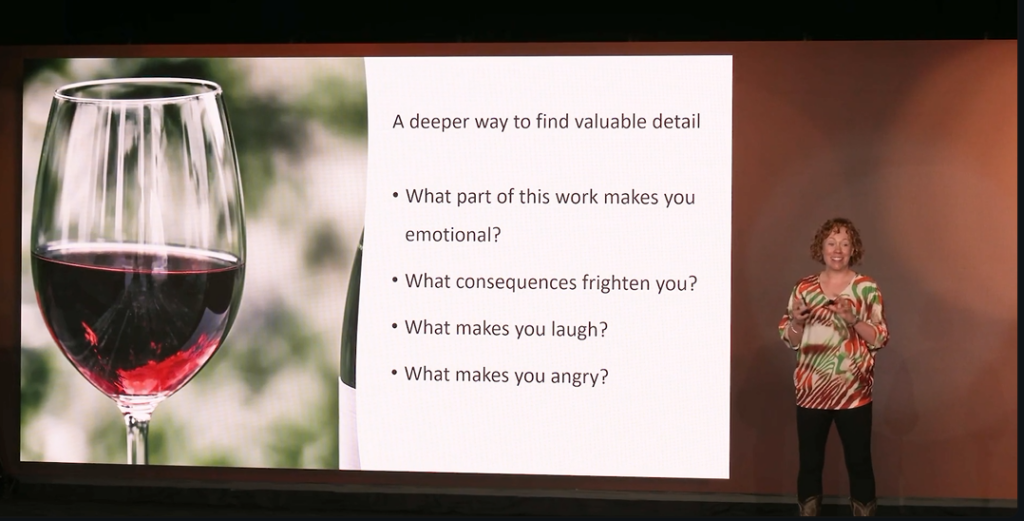
Listen for the moment someone stops saying what they think they should and starts talking with real passion. Record those conversations, then go “panning for gold.”
“You’re already having these conversations. I can hear it around the conference. You’re talking in detail, you’re talking passionately, you care about what you do. You’re sitting on a gold mine,” she said.
Pay special attention to strong emotions like anger, Harrison said, because “when people care enough to rant about something, they are usually specific.”
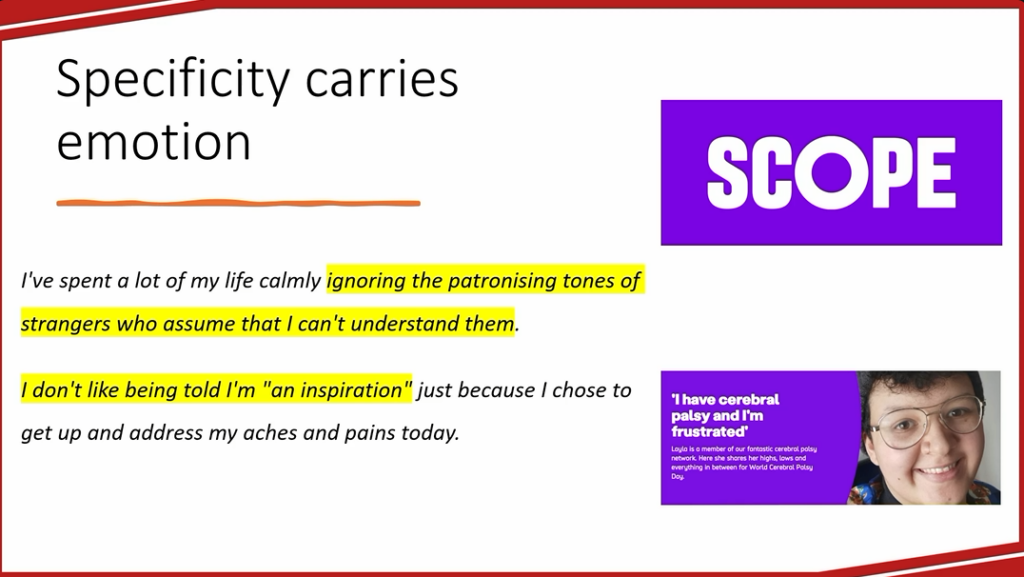
The disability charity Scope used this tactic in UK advertisements. Instead of stating that disabled people face discrimination, it shared people’s specific frustrations, like being patronized, being assumed not to understand and being called an inspiration.
Technique 3: Changing the scale: tell one small story
“When I talk about changing the scale, I want you to specifically shrink the story that you want to tell,” Harrison said. “This is a great storytelling technique if you want to come up with lots and lots of different content ideas.”
TV shows do this all the time, she added, giving Seinfeld as an example – the ultimate “show about nothing,” Harrison noted.
In spite of that billing, its writers built 180 episodes from small entry points, like a sweater with a red dot, or a Pez dispenser.
“Small doesn’t mean insignificant,” she said.
Shrink it. Harrison walked through an exercise using Stamma, a UK charity that supports people who stammer.
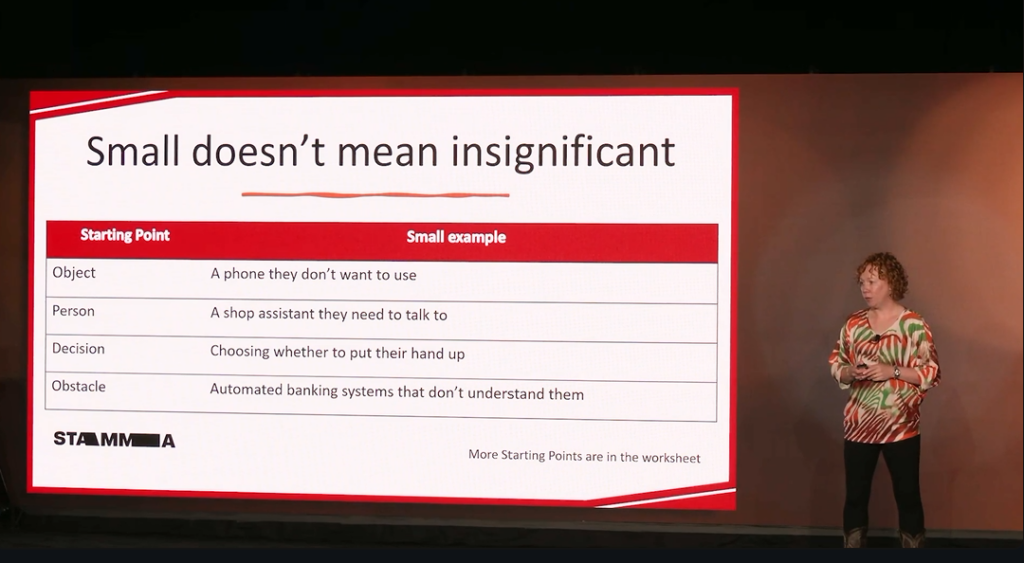
Start with simple prompts: an object, a person, a decision, an obstacle. Then connect each to the cause. For Stamma, that could be a phone someone doesn’t want to use, a shop assistant they’re nervous to talk to, the decision to raise their hand, or an automated system that can’t understand them.
She has watched teams go from saying they have nothing new to say to having a page of ideas that could fuel months of content.
Shrink the story. Then blow it up. Pick one small moment and develop it the way a TV writer develops an episode. Harrison’s questions:
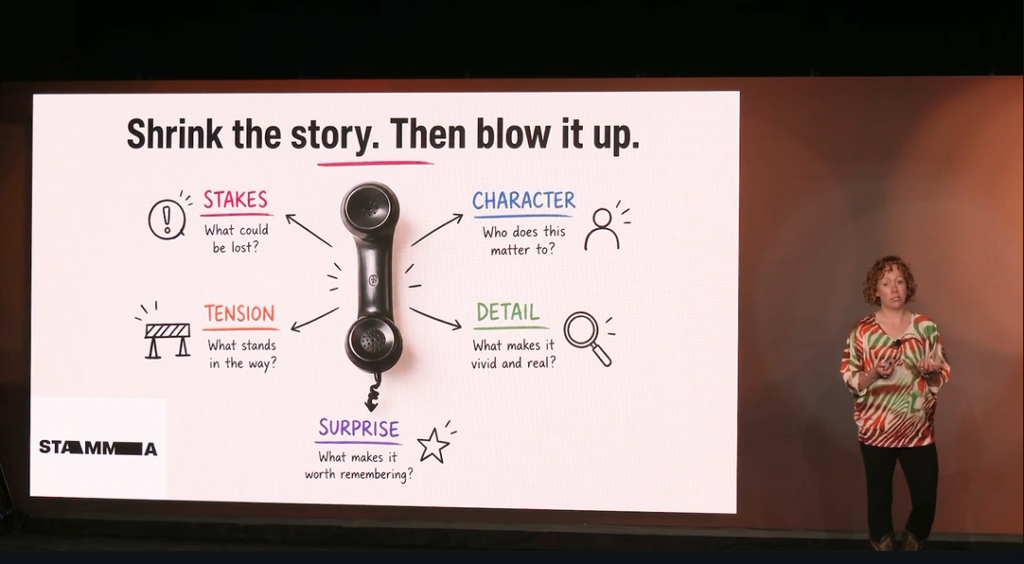
- Who are the characters?
- What’s at stake?
- Where’s the tension? What stands in the way?
- What detail will help people picture it?
- Is there anything surprising that still feels authentic?
Stamma’s own ad does this with a single phone call about collecting a car part. Silence on the line reads as a nightmarish bad connection until the person on the other end says to take all the time they need.
The German aid charity Misereor did it with a loaf of bread. Its Social Swipe billboard accepted card payments, and each two-euro swipe represented daily bread for a family in Peru. As donors walked up to the billboard and swiped their card, they could see a loaf of bread being sliced alongside the swipe of the card.
The lesson, Harrison said, is that you don’t need to cover the full breadth of your work in every piece.
Leading with everything you do is where audiences start to feel they’ve heard it before. A series of small, different stories lets you reach the same people again and again and still engaging them. Start with a small moment or a single person, she said, rather than a mission statement.
Key takeaways
- Use AI for creation, not judgment. Decide what’s worth making before you generate anything.
- List the expected, then find what’s missing. The unseen scene is often the story donors haven’t heard.
- Pair two familiar themes to create contrast without inventing something new.
- Replace impact claims with specific detail. Show one person’s experience instead of saying “empower.”
- Record candid conversations and listen for emotion, especially anger.
- Shrink the story to one object, person, decision or obstacle, then develop it like an episode.
You’re sitting on a goldmine
Harrison closed by noting that film and TV pull audiences into huge worlds through short scenes and small moments, and nonprofits can absolutely do the same.
“You’re absolutely sitting on a goldmine,” she told the audience. The work is finding those stories and having “the confidence to tell a story that other people aren’t telling.”
Put it into practice: Download Amy Harrison’s free nine-page storytelling worksheet, with prompts for every exercise in this session.
NextAfter hosts the NIO Summit every year to help nonprofits learn what’s working in online fundraising. Many sessions are built around real experiments, real data, and practical strategies you can put to work right away.
Want to experience it in person? Join us at the next NIO Summit to learn alongside fundraisers and digital leaders who are testing their way to growth. Can’t wait until then? Watch more NIO Summit sessions and keep learning from the experiments shaping the future of digital fundraising.