

Your Digital-First Readiness Report
Weighted Score: / 100
In the report below, you’ll see how your responses compare to KPIs and common strategies used by digital-first organizations. You’ll also discover helpful next-step resources throughout that you can use to level-up in each key area of your digital fundraising program.
*All benchmarks are based on a sample of 30 nonprofits & NextAfter clients that are actively investing in digital as the primary means of growing their fundraising program.
Your Key Online Fundraising Metrics

There are three primary online fundraising metrics that help simplify and demystify what it takes to grow your digital fundraising program:
- Website Traffic
- Conversion Rate
- Average Gift Size
Multiplying these 3 key metrics together gives you your digital fundraising revenue. This means that if you want to grow your digital revenue, you have three primary levers you can pull.
You can deploy strategies to increase the amount of people coming to your website. You can implement tactics and optimizations to improve the percentage of website visitors that convert into a donor. And you can test new approaches through your copy, messaging, and more to inspire donors to be even more generous.
According to the data you’ve provided, here are your three key online fundraising metrics:

Average Monthly Web Traffic
Your Answer: Sessions per month
Median for a Digital-First Organization: 74,517 Sessions per month
A note on traffic: Not all traffic is equal. Small traffic websites tend to have higher motivations to convert into a donor. Higher traffic websites tend to have many visitors who come primarily to engage with content and articles, meaning they have a lower motivation to donate. Generally speaking, higher traffic means greater opportunity to reach more people and convert more donors.

Average Conversion Rate
Your Answer: %
Median for a Digital-First Organization: .61%
A note on conversion rate: While there is often low-hanging fruit opportunities to boost conversion rate on any website, digital-first organizations may see lower overall conversion rates as they scale their reach using paid media to generate new traffic in search of new donors. If your score is above the benchmark, it may mean your ability to convert traffic into donors is strong. But it also might indicate that your paid media and donor acquisition efforts have high growth opportunities.

Average Gift Size
Your Answer: $
Median for a Digital-First Organization: $105
A note on average gift: When focused heavily on new donor acquisition, overall average gift size is likely to drop. A high average gift size might actually be an indicator that your digital program is not yet at maturity – and there is opportunity to reach a wider audience and grow your donor pool.

Average Monthly Online Revenue
Your Answer: $
Median for a Digital-First Organization: $74,377
A note on online revenue: Good is the enemy of great. So even if your online revenue is comparable to the benchmark (or even above it), there is always opportunity to optimize, improve, and grow.

*We call these metrics the Flux Capacitor of Online Fundraising Maximization. Just as Dr. Emmett Brown in Back to the Future used the Flux Capacitor to power the DeLorean that blasted he and Marty McFly to the future, this Flux Capacitor is going to help you blast your digital fundraising into the future as well.
How to Grow a Digital Fundraising Program
Next Step Resource for Building a Digital-First Growth Plan

Over the past 10 years of building digital programs for countless nonprofit organizations, we’ve decoded the essential playbook to growing a digital program regardless of your size and resources. It all comes down to 3 key ingredients.
In this 1-hour course taught by NextAfter’s president, Jeff Giddens, you’ll discover a framework for leveraging 3 key ingredients to systematically and sustainably grow your digital fundraising program.
Activate the Free Course »Analyzing Your Email & Donor Acquisition Efforts
What is the size of your email subscriber list?
Your Answer: Subscribers
When comparing to digital-first organizations, 97% have an email subscriber list that is larger than 10,000 contacts. And 69% have at least 100,000 email subscribers. This is because digital-first organizations know that the size and quality of your email subscriber list is the best indicator of your ability to raise more money online.
There are many tactics that you can use to start growing your email subscriber list – whether you have a few thousand contacts, hundreds of thousands, or even millions. But the most effective tactics to acquire new emails that lead to new donors rely on what we call content offers.

A content offer is piece of valuable content that someone can get for free in exchange for an email address. This can include:
- Surveys
- Quizzes
- Petitions
- eBooks
- Free courses / Video Series
- And more.
That’s why we asked you about which kinds of offers you are using currently.
Which of the following content offers are you using in your email & donor acquisition efforts?
Your Answer:
These kinds of content offers can serve two main purposes.
Purpose #1 – Content offers provide something useful and valuable to potential donors to engage them with your organization in a meaningful way. They are perfect for use in digital advertising to reach new audiences, convert new subscribers, and prompt them to make their first donation.
Purpose #2 – Content offers provide something useful and valuable to existing donors to cultivate them in a meaningful way and prompt them to give again.
How can a content offer prompt someone to donate? Use an instant donation page.
When sharing a content offer, we always put them behind an email acquisition form. This email acquisition form requires some level of investment for the user to take action, helping solidify the feeling that what they’re getting is indeed valuable.
After the form is submitted, they land on what we call the Instant Donation Page. The instant donation page confirms that the survey/petition/quiz is complete or that their ebook/course/video is on its way to their inbox. The page then immediately moves into a donation appeal – often asking the user to donate to reach more people with the offer they’ve just received.

In this way, the instant donation page provides a funnel for new subscribers to become new donors and for existing donors to give again. Using a donation page tool like iDonate will let you create as many donation pages as necessary using an Instant Donation Page template so you can grow and scale these content offer funnels as your program grows.
Developing content offer funnels that lead towards opportunities to give again is a critical part of both donor cultivation and donor retention.
That’s why we asked you about your donor retention rates. There’s a common misconception that online donors have poor retention rates and aren’t nearly as valuable as donors who give through offline or traditional channels.
But digital-first organizations are seeing something different.
On the next tab, we’ll look at how your online donor retention rates compare to digital-first organizations in the next section.
Donor Acquisition: A Proven 4-Step Model to Acquire New Donors Online
Next Step Resource for Acquiring New Emails and New Donors
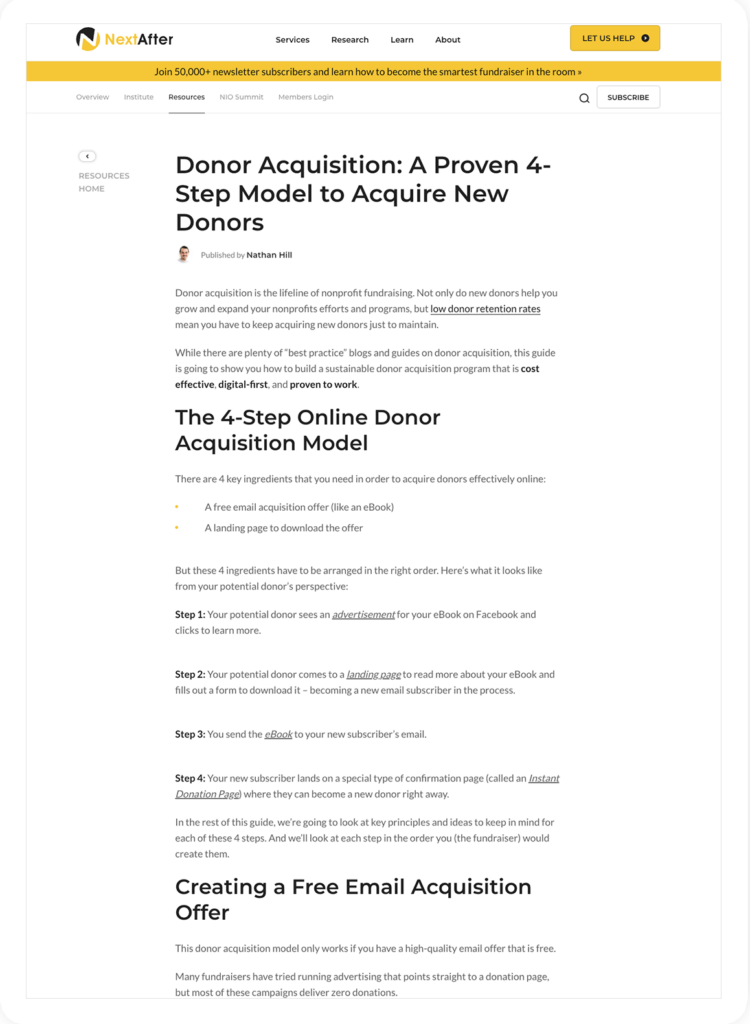
In this article on donor acquisition, you’ll find an in-depth outline of a proven model for acquiring new donors online. This proven donor acquisition model uses 4 key ingredients:
- An email offer
- A landing page
- Advertising
- And an instant donation page
Learn how to start building a sustainable online donor acquisition funnel using this proven methodology by reading the article at the link below.
Read the Article on Donor Acquisition »A Closer Look at Your Donor Retention Rates

What is your retention rate for a new online donor?
Your Answer:
Digital-First organizations have an average new online donor retention rate of 32.8%. According to the 2023 M+R Benchmarks, across the industry, the average new online donor retention rate is 16%. That means digital-first organizations have a 42% higher retention rate for online donors than the average nonprofit.

What is your retention rate for a multi-year online donor?
Your Answer:
The average multi-year online donor retention rate is 63.2% for digital-first organizations. This is 5% higher than the average nonprofit according to the 2022 M&R Benchmarks.
Why is this important to call out? Because those who are investing in digital-first strategies are outperforming others in the industry in one of the most critical areas of fundraising. Overall donor retention rates have plagued our industry for many years – forcing many nonprofits to invest hundreds of thousands—if not millions—of dollars in acquisition in order to offset the churn of their existing donor file.
Even small wins in retention can have massive implications for your bottom line—and your impact as an organization.
Online Donors are the Best Fuel for Your Most Valuable Donors
Putting digital first can certainly boost the retention rates of your online donors – bringing them up to par with retention rates of offline donors. But digital-first fundraising helps you generate more donors that are more likely to become your most valuable donors in the long term: multichannel donors.
Multi-channel donors are your most valuable donor segment. These are donors who give across both online and offline channels.
According to NextAfter client data, multi-channel donors have higher Lifetime Values and higher retention rates than any other donor segment. In fact, we’ve found that multi-channel donors can generate 230% more revenue than an online-only donor and 210% more revenue than an offline-only donor.
But here’s the kicker…
When we’ve analyzed what donor types convert to multi-channel donors at digital-first organizations, online-acquired donors are 235% to 11,200% more likely to become a multi-channel donor than an offline-acquired donor.

I’ll say that one more time…
Donors that you acquire online are at least 235% more likely to become your most valuable donors.
But this doesn’t happen magically. You must make a strategic investment in your digital fundraising program to see this kind of result.
On the next tab, we’ll look at what investments you’re making in digital technology and how they compare to digital-first organizations.
The Comprehensive Online Donor Retention Benchmark
Next Step Resource for Improving Donor Retention

In this research study, you’ll discover what we learned by analyzing the donor retention performance of 211 organizations and comparing their performance to the actual experience of a new donor.
By analyzing retention performance and the donor experience, we can pinpoint the common trends that are leading to higher retention rates and greater revenue.
See what we’ve discovered works to improve donor retention in the donor retention benchmark report.
Get the Donor Retention Report »Digital-First Technology
When it comes to digital and web technology, the number of tools you could add to your tech-stack are seemingly endless. And I’m sure I don’t need to tell you that every single one of the digital fundraising tools out there is going to try to convince you that they are essential to your growth.
The reality is that tools don’t lead to growth. The right strategy leads to growth, and the best tools are the ones that empower your strategy.
That said, there are some essential tools that you need in your digital fundraising toolkit to empower effective digital strategies. We asked you about several of these in the assessment.
Do you and your fundraising staff actively use Google Analytics?
Your Answer:

You can’t optimize what you can’t measure. And Google Analytics 4 is the primary tool that nearly every digital fundraiser and marketer uses to analyze activity on their website and make data-informed decisions about how to optimize their digital efforts.
Having Google Analytics installed on your website is only the starting point. The fundraisers at digital-first organizations have direct access to their analytics platform and use it at least weekly to make sure systems are working, answer key performance questions, and inform strategic decisions.
Do you have a CRM to track and manage donor activity?
Your Answer:
A high-quality and modern CRM system is an essential tool for any fundraising program. But some are better than others when it comes to supporting a digital-first fundraising program. The most effective CRM platforms allow you to push data in and out with ease, integrating with the other critical digital fundraising tools in your tech-stack.
Your CRM should not be a tool that’s so complex it can only be used by a trained IT staff member. It should be a tool that gives the fundraiser all the data they need to make strategic decisions at their fingertips – and push donor data into other communication tools with the click of a button (or even an automation).
Do you use an email marketing or automation tool?
Your Answer:
We discussed earlier that the size and quality of your email list is the best indicator of your ability to raise money online. But this is only true if you have the tools in place to send humanized, personal emails to donors and subscribers at scale.
Your email automation tool should empower you to craft automations including: new subscriber welcome series, new donor welcome series, custom follow-up emails based on content download, cultivation journeys based on website activity.
Do you have a dedicated donation page tool or platform?
Your Answer:
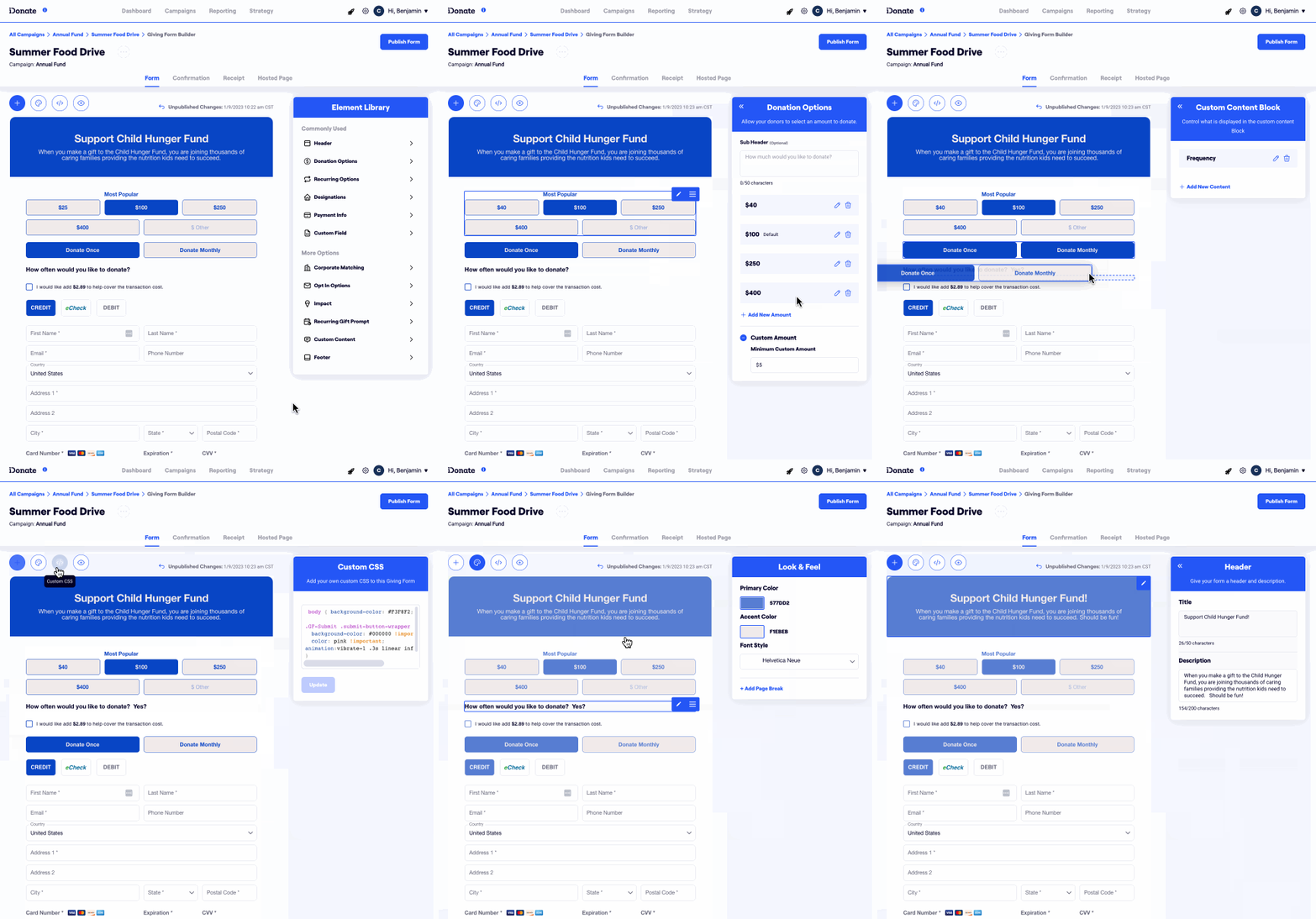
Not every donation page tool or platform is equal. The most effective donation page platforms allow you a wide range of flexibility to customize to the needs of your campaign and test any element on the page.
Digital-first organizations are using donation page tools that allow them to:
- Create as many custom donation pages as needed.
- Install analytics tracking easily.
- Edit and tweak every element of copy on the page.
- Add custom HTML, CSS, and scripts to support any customizations you need.
- Run a/b testing and experimentation. (*iDonate lets you run a/b testing on your pages without any additional tools)
Are you able to create landing pages without the need for IT or developer involvement?
Your Answer:
This is often a key missing ingredient between average nonprofits and those that are seeing significant digital growth. Fundraisers and nonprofit marketers alike need the autonomy to create custom pages for campaigns without the need to ask a developer for help each time.
Whether you’re running a campaign to get more newsletter subscribers, offer a free eBook or resource, promote a course or video series, or get more survey completions and petition signers, a landing page builder is critical to empowering the success of a digital fundraising program.
Do you have a tool for running a/b testing on your website and donation pages?
Your Answer:
Testing is the bedrock of every high-functioning digital fundraising program. If you’re not putting your ideas and hypotheses to the test, you’ll never know what actually works to grow giving.
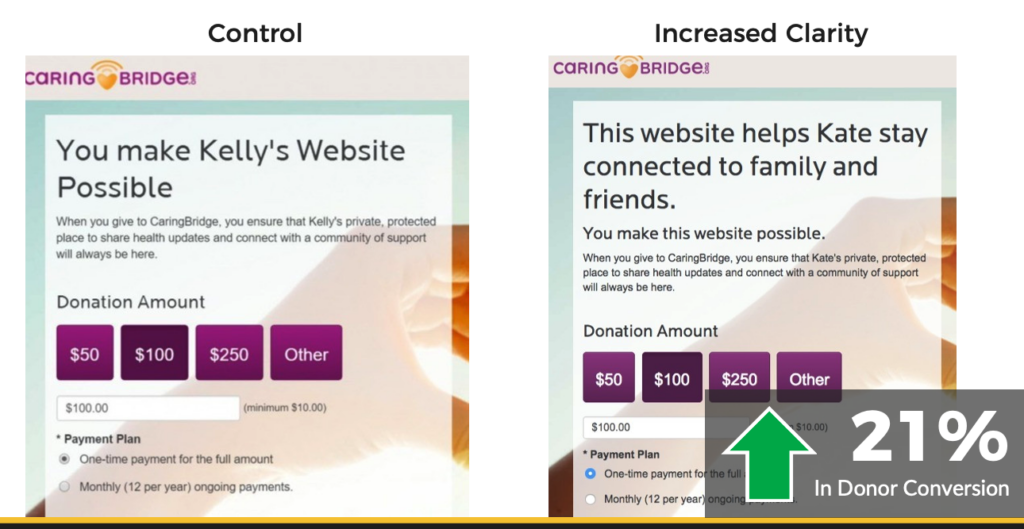
Any email marketing tool worth paying for will have a/b testing built in. But testing on your website and donation pages normally requires an additional tool. Google Optimize has been the go-to source for many digital-first nonprofits because it is free. But with its sunsetting in September 2023, nonprofits need to invest in an additional a/b testing and optimization tool.
Our recommended tool to a/b test across your website is VWO.
But if you just need a/b testing capabilities on your donation page, iDonate integrates a/b testing directly into their donation platform.
You Need More than Just Good Tools
The tools above don’t represent every tool you might need to implement effective digital-first fundraising strategies, although they are some of the most critical. As we said before, tools don’t lead to growth. The best tools empower effective digital-first strategies.
That’s why we also asked you a few simple questions about your digital fundraising plans and strategies. In the next section, we’ll look to see how you are utilizing your digital tools to implement effective digital-first fundraising strategies.

A Preferred Donation Page Platform
Next Step Resource for Improving Your Donation Page Platform
There are so many tools to choose from when it comes to your digital fundraising. If you’re looking for a platform for testing & optimization on your donation pages, iDonate is our preferred donation page platform.
Their iDonate 2.0 platform includes donation page templates that are built on tested and proven tactics from our library of 5,000+ online fundraising experiments. A/B testing is built right into the platform so you can test everything from your copy, to page layouts, to form fields, and more.
You can learn more about iDonate at www.idonate.com.
Learn More About iDonate »Digital-First Strategies
Simply having the right digital fundraising tools and platforms in place does not guarantee results. You have to use them to implement effective digital fundraising strategies.
While every organization has a unique cause, differing donor motivations, and levels of sophistication, there are a few baseline strategies and tactics that nearly every digital-first organization is utilizing to grow their digital fundraising.
Have you tested your donation form within the past month to make sure it’s functioning?
Your Answer:
In a 2022 research study called The New Donor Welcome Study, we analyzed what it was like to be a new donor to 150 organizations. But 7% of our attempts to donate failed. And this is not the first time we’ve seen this problem.
At a minimum, you should put a test donation through your main donation form every month. This will help you make sure that it’s working, but it will also help you experience what a donor goes through every time they give. Developing this habit can give you more empathy for your donors and generate new ideas to test and improve the experience.

Do you have an a/b test running right now?
Your Answer:
You can have the most elite and renowned strategists developing ideas for your fundraising. And you can consume all the latest fundraising research to inform your approach. But the reality is that you can’t know that something works until you put it to the test.
Every effective digital-first organization should have a comprehensive a/b testing plan. With a comprehensive testing plan, it’s rare to have a moment in time when there’s not a test running on either a donation page, advertising campaign, email appeal, or something else on the website.

Was your last email appeal sent from the name of your organization or from the name of a person?
Your Answer:
A mantra that we live by at NextAfter is this: “People give to people, not to email machines.”
Now, we didn’t make up this mantra because it sounded nice. It’s based on learnings our library of 5,000+ online fundraising experiments. A common thread amongst every growing and successful email fundraising strategy is that email is being used to foster and grow a relationship with the donor. And this starts with sending your emails from actual people.
Sending from a real person has impact in several areas: it gets better inbox placement, it builds more trust with the recipient, it allows you to build a human connection with your donors, it generates real email replies, and it leads to more donations and revenue.

Are you currently running paid ads for email acquisition?
Your Answer:
The only way to meaningfully grow your email subscriber list is to reach out beyond your walls and find likely new donors to engage with content. While you need the right offers, strategy, and creative for it to be effective – the primary way to reach new audiences is through paid media and advertising.
But email acquisition on its own is a short-sighted strategy. It must be paired with an intentional donor acquisition strategy.
Are you currently running paid ads for donor acquisition?
Your Answer:

The primary focus of your advertising dollars should be on donor acquisition. Growing digital programs often feature content offers like eBooks, surveys, petitions, and courses as a means of acquiring an email address right away. But the advertising is being optimized for donor acquisition.
Most digital-first organizations utilize an instant donation page in place of a standard confirmation page after a new subscriber fills out a form to accept the free offer. This allows you to lead with valuable content and build a clear funnel towards converting new subscribers into new donors right away.
Does a new donor receive a personal thank you email within 48 hours?
Your Answer:
There’s nothing magical about the “48 hour” number in this question. The intention is that your donor gets thanked for their donation via email right away. You may also compliment this with sending “thank you” communication in other channels. Sadly, we’ve seen that upwards of 18% of nonprofits don’t send any “Thank You” communication to new online donors.

Does a new donor receive an automated, email welcome series?
Your Answer:
Saying “Thank You” right away is only the first step. A new donor should receive consistent, automated email communication within their first few weeks of donating. The common approach to new donor welcome series is to send a series of branded communication informing new donors about the organization, share stories of impact, and make a direct donation appeal.
Digital-first organizations are often adopting a different approach. The most successful new donor welcome series look like plain-text emails. They are sent from human beings with the aim of cultivating a real relationship. These emails often ask for a reply to engage deeper. And they leverage content offers to cultivate these new donors while creating a path towards a second gift.
Is a new donor asked for a second donation within 90 days?
Your Answer:
For some fundraisers and nonprofits, it may feel taboo to ask for a second gift so soon. But we’ve analyzed digital-first organizations to understand when donors make a second gift. This analysis has shown that some organizations see as high as 44% of second donations come in during a new donors first 90 days.
Is a new donor asked to become a monthly recurring donor within 90 days?
Your Answer:
Recurring donations are one common and effective method to boost donor retention rates. But many nonprofits struggle to figure out how to build their recurring donor file. The simplest way to get start is to send a simple email. In fact, many growing digital fundraising programs have an automated email campaign to ask new one-time donors to become a monthly recurring donor.
Digital-first organizations see significant variance in recurring donors – and this has a lot to do with the type of organization and their specific cause. That said, 39% of online donors to digital-first organizations are giving recurring donations. When we asked you about this in the assessment, you said that of your online donors are giving a recurring monthly donation.
How many emails do you typically send to your subscribers and donors during the year-end season (Nov. 15 – Dec. 31st)?
Your Answer:

There is no one-size-fits-all strategy when it comes to year-end email campaigns. But when we design year-end email campaigns for digital-first organizations, they will often have anywhere from 8 to 12 emails sent between November 15th and December 31st.
These are not all direct fundraising appeals. The most effective year-end fundraising campaigns utilize a mix of cultivation and appeals to engage potential donors, help them understand the impact of a donation, and activate them before the year-end deadline.
How many high-urgency fundraising campaigns do you run during the year outside of the year-end season?
Your Answer:
Nonprofits who are still in their infancy in terms of digital fundraising will run one high-urgency campaign each year. Most commonly, this one campaign is at the end of the calendar year or aligned with the end of their fiscal year.
The leading digital-first organizations run a high-urgency campaign 3 to 4 times per year, often once per quarter. Each quarter, their fundraising campaigns follow a similar rhythm: month 1 is focused on acquiring more names and emails, month 2 is focused on cultivation, and month 3 is focused on activating new and existing donors with a high-urgency campaign.
NextAfter Institute Membership Free-Trial
Next Step Resource for Learning Proven Digital Fundraising Tactics and Strategies

One of the biggest barriers to growing a digital-first program is having the right staff and teams in place who know how to run the most impactful digital strategies.
Whether you have a veteran digital-fundraising team or you’re just getting started with digital fundraising, the NextAfter Institute is designed to equip you with proven tactics for growth.
You can get a 30-day free trial of a NextAfter Institute membership and gain access to a library of 10+ online fundraising courses that cover the spectrum of:
- Email Fundraising
- Donation Page Optimization
- Online Donor Acquisition
- A/B Testing
- Google Analytics 4
- And much more.
Activate your free NextAfter Institute membership trial at nextafter.com/membership
Activate a Free NextAfter Institute Membership »Digital-First and Ready to Optimize
Based on your scores, it seems like you have the essentials in place to be a digital-first organization. On top of that, you have high performance in many key areas already, meaning that the strategies you’ve put into place are delivering meaningful digital fundraising results.
However, good is the enemy of great. And there is always room to optimize. So don’t let the good work you’re doing slow down!
Below I’ve outlined a few next steps that I’d recommend for to continue to grow and optimize your online fundraising performance.
Recommended Next Steps
- Activate a free WinstonKnows account to keep track of all your a/b testing. As you test and optimize your program, the worst thing that could happen is that your hard-earned learnings get forgotten, lost in an excel file somewhere, or walk out the door if an employee takes a new position.
Winston will allow you to integrate your testing tools, keep track of all your experimentation in a single library, and continuously decode what works to grow giving and generosity at .
You can activate a free WinstonKnows account at winstonknows.com. - Review the most recent digital fundraising research from the NextAfter research lab. We are hard at work trying to understand what tactics nonprofits are using to try and grow giving, as well as prove what tactics truly work using experimentation. You can get access to all the latest digital-fundraising research for free at nextafter.com/research.
- Make sure your teams are equipped with the digital fundraising training they need to develop optimization strategies for each key area of your online fundraising. You can activate a free 30-day trial of our NextAfter Institute membership and get access to all our on-demand online fundraising trainings. And if you’d like to get a membership for everyone on your team, you can do so at a significant discount at nextafter.com/team-membership
- Learn more about how to take your digital program to the next level. Our mission is to decode what works in fundraising and equip as many nonprofits as we can with what we’re learning. So regardless of whether we work directly together or not, we’re committed to serving you and helping you grow your program by sharing our learnings.
That said, if you really want to take your digital fundraising program to the next level, we’d love to have a conversation to see if there is a good fit for us to partner together to decode what works to grow giving at .
Let us know you’re interested at nextafter.com/let-us-help, and someone will be in touch with you shortly to schedule a call to see if there’s a way we can partner together to grow your digital program.
Digital-First Ready
Based on your scores, you’re ready to become a digital-first organization. You have several essential tools and strategies in place as well as some key areas of high digital performance already.
You’re more than welcome to utilize the resources linked throughout the report to deepen your knowledge and digital fundraising expertise. But we’d love to have a conversation with you to chat about next steps.
We work with roughly 50 nonprofit organizations to help them put digital in a position to lead their fundraising efforts, and they’re seeing high performance as a result. I think that there would be a great fit for us to work together with your team at to grow and optimize your program.
If you’d like to have an initial conversation to explore what a research partnership might look like, let us know you’re interested at nextafter.com/let-us-help. Someone will be in touch with you shortly to schedule a call.
Below I’ve outlined a few next steps that I’d recommend for to continue to grow and optimize your online fundraising performance.
Additional Next Steps
In the meantime, there are a few additional resources that may help you get some quick wins in your digital fundraising.
- Activate a free WinstonKnows account to keep track of all your a/b testing. As you test and optimize your program, the worst thing that could happen is that your hard-earned learnings get forgotten, lost in an excel file somewhere, or walk out the door if an employee takes a new position.
Winston will allow you to integrate your testing tools, keep track of all your experimentation in a single library, and continuously decode what works to grow giving and generosity at .
You can activate a free WinstonKnows account at winstonknows.com. - Review the most recent digital fundraising research from the NextAfter research lab. We are hard at work trying to understand what tactics nonprofits are using to try and grow giving, as well as prove what tactics truly work using experimentation. You can get access to all the latest digital-fundraising research for free at nextafter.com/research.
- Make sure your teams are equipped with the digital fundraising training they need to develop optimization strategies for each key area of your online fundraising. You can activate a free 30-day trial of our NextAfter Institute membership and get access to all our on-demand online fundraising trainings. And if you’d like to get a membership for everyone on your team, you can do so at a significant discount at nextafter.com/team-membership
- Attend the Nonprofit Innovation & Optimization Summit. This annual conference for nonprofit marketers and digital fundraisers is specifically designed to be radically different from any other nonprofit event. You’ll hear from many for-profit marketing innovators that have cutting-edge ideas that we believe can lead to major improvements in digital fundraising.
On top of great speakers and learnings, you’ll have an absurd amount of fun connecting with other likeminded nonprofits and digital fundraisers.
You can learn more and get tickets at niosummit.com. - Learn more about how to take your digital program to the next level. Our mission is to decode what works in fundraising and equip as many nonprofits as we can with what we’re learning. So regardless of whether we work directly together or not, we’re committed to serving you and helping you grow your program by sharing our learnings.
That said, if you really want to take your digital fundraising program to the next level, we’d love to have a conversation to see if there is a good fit for us to partner together to decode what works to grow giving at .
Let us know you’re interested at nextafter.com/let-us-help, and someone will be in touch with you shortly to schedule a call to see if there’s a way we can partner together to grow your digital program.
Approaching Digital-First Readiness
Based on your scores, you have several of the essential building blocks to becoming a digital-first organization, but there’s still more work to do.
Use the report as a guide to help you lock-in the right tools, technologies, and essential strategies that will set you on a path towards digital success.
And if you’d like any help to make sure that is on the right path towards digital growth, we’d love to have a conversation. In fact, there may be a way we can work together to help you develop a roadmap that charts your course to digital fundraising growth.
If you have high web traffic (10k+ unique visitors per month), $5 Million in total annual revenue, or have a board that is ready to make a strategic investment in growing a digital fundraising program, it’s worth having conversation to see if there’s a good fit for us to partner together to grow your digital program.
Let us know you’re interested at nextafter.com/let-us-help, and someone will be in touch with you shortly to schedule a call to see if there’s a way we can partner together to grow your digital program.
Additional Next Steps
In addition to the resources throughout the report, there are a few additional resources that may help you get some quick wins in your digital fundraising.
- Activate a free WinstonKnows account to keep track of all your a/b testing. As you test and optimize your program, the worst thing that could happen is that your hard-earned learnings get forgotten, lost in an excel file somewhere, or walk out the door if an employee takes a new position.
Winston will allow you to integrate your testing tools, keep track of all your experimentation in a single library, and continuously decode what works to grow giving and generosity at .
You can activate a free WinstonKnows account at winstonknows.com. - Review the most recent digital fundraising research from the NextAfter research lab. We are hard at work trying to understand what tactics nonprofits are using to try and grow giving, as well as prove what tactics truly work using experimentation. You can get access to all the latest digital-fundraising research for free at nextafter.com/research.
- Make sure your teams are equipped with the digital fundraising training they need to develop optimization strategies for each key area of your online fundraising. You can activate a free 30-day trial of our NextAfter Institute membership and get access to all our on-demand online fundraising trainings. And if you’d like to get a membership for everyone on your team, you can do so at a significant discount at nextafter.com/team-membership
- Attend the Nonprofit Innovation & Optimization Summit. This annual conference for nonprofit marketers and digital fundraisers is specifically designed to be radically different from any other nonprofit event. You’ll hear from many for-profit marketing innovators that have cutting-edge ideas that we believe can lead to major improvements in digital fundraising.
On top of great speakers and learnings, you’ll have an absurd amount of fun connecting with other likeminded nonprofits and digital fundraisers.
You can learn more and get tickets at niosummit.com. - Learn more about how to take your digital program to the next level. Our mission is to decode what works in fundraising and equip as many nonprofits as we can with what we’re learning. So regardless of whether we work directly together or not, we’re committed to serving you and helping you grow your program by sharing our learnings.
That said, if you really want to take your digital fundraising program to the next level, we’d love to have a conversation to see if there is a good fit for us to partner together to decode what works to grow giving at .
Let us know you’re interested at nextafter.com/let-us-help, and someone will be in touch with you shortly to schedule a call to see if there’s a way we can partner together to grow your digital program.
You’ve Got Some Work to Do, But We’re Here to Help
Based on your scores, you’re not quite ready to lean into digital fundraising as the key driver of your organization. But there are a few potential exceptions.
If you have high web traffic (10k+ unique visitors per month), $5 Million in total annual revenue, or have a board that is ready to make a strategic investment in growing a digital fundraising program, you might still be ready to take the leap.
Building a high-performing digital fundraising program from scratch takes time and financial investment. If you meet one of the exceptions above and would like to see if there’s a fit for us to work together to grow your digital program, let us know you’re interested at nextafter.com/let-us-help. Someone will be in touch with you shortly to schedule a call to see if there’s a way we can partner together to grow your digital program.
Additional Next Steps
In addition to the resources throughout the report, there are a few additional resources that may help you get some quick wins in your digital fundraising.
- Activate a free WinstonKnows account to keep track of all your a/b testing. As you test and optimize your program, the worst thing that could happen is that your hard-earned learnings get forgotten, lost in an excel file somewhere, or walk out the door if an employee takes a new position.
Winston will allow you to integrate your testing tools, keep track of all your experimentation in a single library, and continuously decode what works to grow giving and generosity at .
You can activate a free WinstonKnows account at winstonknows.com. - Review the most recent digital fundraising research from the NextAfter research lab. We are hard at work trying to understand what tactics nonprofits are using to try and grow giving, as well as prove what tactics truly work using experimentation. You can get access to all the latest digital-fundraising research for free at nextafter.com/research.
- Make sure your teams are equipped with the digital fundraising training they need to develop optimization strategies for each key area of your online fundraising. You can activate a free 30-day trial of our NextAfter Institute membership and get access to all our on-demand online fundraising trainings. And if you’d like to get a membership for everyone on your team, you can do so at a significant discount at nextafter.com/team-membership
- Attend the Nonprofit Innovation & Optimization Summit. This annual conference for nonprofit marketers and digital fundraisers is specifically designed to be radically different from any other nonprofit event. You’ll hear from many for-profit marketing innovators that have cutting-edge ideas that we believe can lead to major improvements in digital fundraising.
On top of great speakers and learnings, you’ll have an absurd amount of fun connecting with other likeminded nonprofits and digital fundraisers.
You can learn more and get tickets at niosummit.com.
A Preferred Partner for Donation Pages
No single tool can fulfill all your fundraising strategies. In fact, most all-in-one fundraising platforms only do one or two things well. So our recommendation is to always find the best single tool for the tactic or strategy at hand.
And when it comes to creating donation pages, we’ve worked with the team at iDonate to help ensure that their iDonate 2.0 platform is the best option on the market to empower digital-first fundraising strategies.
Amongst a lot of other features, iDonate 2.0 accomplishes two critical things that will help empower digital-first fundraising strategies:
Native Templates Based on Tested & Proven Strategies
iDonate 2.0 includes one-standard donation page templates that are based on donation page optimization principles that we’ve proven over 5,000+ online fundraising experiments. These templates let you start with a more optimized page so you can test your way into new and innovative strategies.
Integrated A/B Testing for Donation Pages
You can run an a/b test on every donation form and donation page you create in iDonate 2.0 with just a few clicks. Within the donation page editor, you can design, deploy, and evaluate a/b tests that will help you unlock what truly works to inspire greater generosity from your donors.
If you want to learn more about iDonate 2.0 and how it can empower digital-first fundraising strategies for your organization, you can learn more at www.idonate.com.
Learn More About iDonate »